

















Pokie Machine Tips: A Quantitative Guide to Maximising Your Bankroll and EV
Pokie players often search for a secret pattern or a machine that is about to pay, but the maths is less romantic. Every pokie is built with a house edge, and over enough spins that edge will pull results toward the casino. The useful question is not how to guarantee a win; it is how to reduce unnecessary exposure, make informed choices, and keep a negative mathematical situation under control. A quantitative approach replaces hope with limits, records, and an honest reading of expected value. It will not make you immune to losses, but it can make your play more deliberate and your bankroll last longer.
Read Expected Value Before You Spin
Expected value, or EV, is the average outcome a wager would produce if repeated many times. A game with 96.51% return to player has a 3.49% house edge, so $100 wagered has an expected loss of $3.49 over an infinite series. Across online pokies, house edges commonly sit between 2% and 10%, although individual titles vary. That does not mean each $100 session loses exactly that amount. Variance can make short sessions feel generous or brutal, which is why players remember lucky streaks and forget the maths. A 500-spin run at $0.50 puts $250 through the machine; an actual loss of around $15 in one such test shows how far short-term results can drift from the theoretical average. Use RTP as a comparison tool, not a promise. Higher RTP is better than lower RTP, all else equal, but it never removes the house edge.
Build a Bankroll You Can Defend
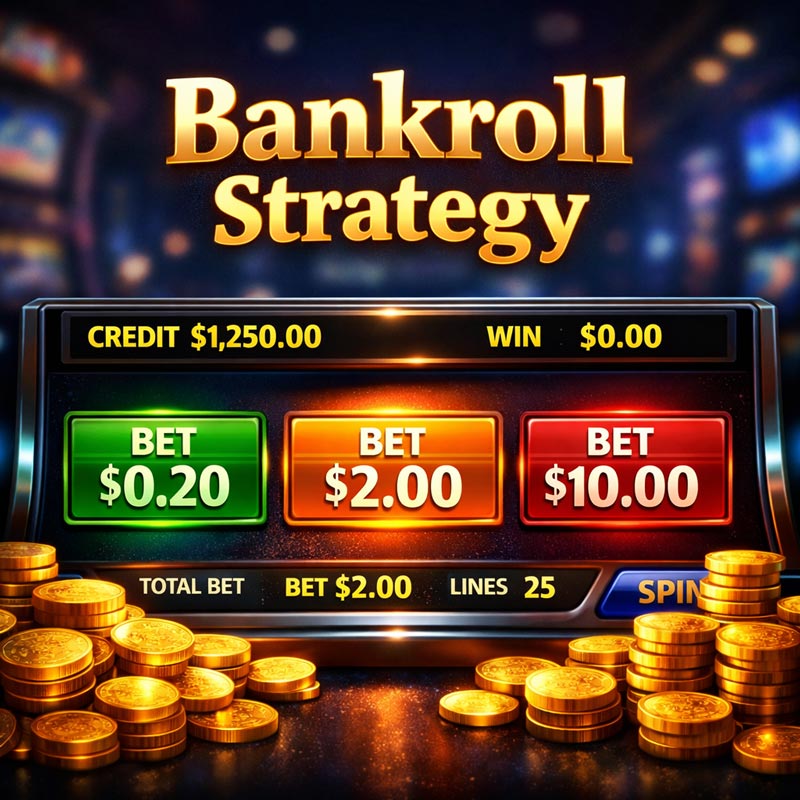
Treat your pokie bankroll as working capital with a hard boundary, not as spare cash that can be topped up whenever a session turns sour. Keep it separate from everyday money, bills, and savings. A dedicated fund of at least $500, and ideally closer to $1,000, gives a more realistic cushion for extended play and normal swings. The exact figure matters less than the principle: the money must be yours to lose without affecting essential spending. If the bankroll is small, reduce the stake rather than borrowing from another pot. The fortress mindset is simple. Build the fund first, decide what it can afford to lose, and do not weaken the walls halfway through a losing run.
Set a One Percent Session Stop
The one percent rule is a practical way to quantify exposure. A session, or a cluster of high-volatility wagers, should never put more than 1% of the bankroll at risk. On a $1,000 bankroll, that means a maximum session loss of $10 before you stop. This can feel absurdly cautious when a single spin costs $1 or $2, but that is exactly why the rule has value. It forces you to choose stakes and session length before emotion takes over. A stop-loss is not an insult to your skill; it is a limit on ruin. If you hit the cap, leave. Chasing losses is how a controlled session becomes an expensive one.
Match Stake and Volatility to Your Plan
Stake size should be derived from the bankroll and the loss limit, not from the size of the win you hope to collect. High-volatility games can produce long dry spells and sharp swings, so they demand more patience and a smaller stake if you want to survive the ride. A lower stake buys more spins, which gives the maths more time to play out and reduces the chance that one bad patch ends the session. Session length should be planned in advance. Decide how many spins or how much time you will allow, then stop when either limit is reached. Tracking results helps you see whether your actual play matches your plan, rather than relying on memory and adrenaline.

Use Promotions and Game Information Wisely
Promotions, loyalty schemes, and VIP invitations can add value, but they do not change the fundamental nature of a negative-EV game. Read the terms and compare the effective cost of play with the benefit offered. A bonus that extends playtime may be useful if the conditions are realistic; one that locks funds or encourages oversized bets may simply increase exposure. Game information matters as well. Check the published RTP where available and remember that versions can differ between operators or settings. A slightly better RTP is a rational reason to choose one game over another, but it is not a reason to abandon limits. The casino still holds the edge, so every decision should reduce friction on your bankroll rather than increase it.
Ignore Superstition and Trust the Process
Pokies do not become due, hot, cold, or ready to pay because of previous spins. Near misses and patterns are part of the experience, not reliable signals. The disciplined player focuses on what can be controlled: bankroll size, stake, time, stop-losses, and the quality of the game's published maths. Keep a simple record of sessions if you want to improve. It does not need to be elaborate; a note of starting bankroll, stake, time played, and result is enough. The aim is not to prove you can beat the house. It is to make sure the cost of entertainment stays within the budget you set.
There is no set of tips that turns a negative-EV pokie into a guaranteed winner. The real edge for a player is discipline: choose better-returning games where possible, keep a separate bankroll, apply a strict session stop, size stakes sensibly, and ignore the urge to chase. Done consistently, these habits will not beat the casino, but they can protect your bankroll and make your play more controlled.

0 تعليقات
لا توجد تعليقات بعد. كن أول من يشارك تجربته.